Why Pull-Up Diaper (Pants Diaper) Production Lines Are the Fastest-Growing Segment in Hygiene Manufacturing
May 21, 2026
The global hygiene product market has witnessed a significant shift in recent years. While traditional baby diapers and adult incontinence products remain steady, one category is growing at an unprecedented rate: pull-up diapers (also known as pants diapers, training pants, or disposable underpants). For manufacturers looking to expand their product portfolio or upgrade existing capacity, investing in a dedicated pull-up diaper production line is no longer optional — it is a strategic necessity.
The Market Demand Behind the Growth
Pull-up diapers serve a unique crossover audience. Toddlers transitioning from traditional diapers to toilet training prefer the underwear-like fit that pull-ups provide. Meanwhile, many active adults with light to moderate incontinence also find pull-up style products more discreet and comfortable than tape-style adult diapers. This dual demand base creates a larger addressable market than any single diaper category. In developing regions across Asia, Africa, and Latin America, rising disposable income and urbanization are accelerating adoption, making pull-up diapers one of the fastest-moving SKUs in hygiene product retail.
Key Technical Differences from Traditional Diaper Machines
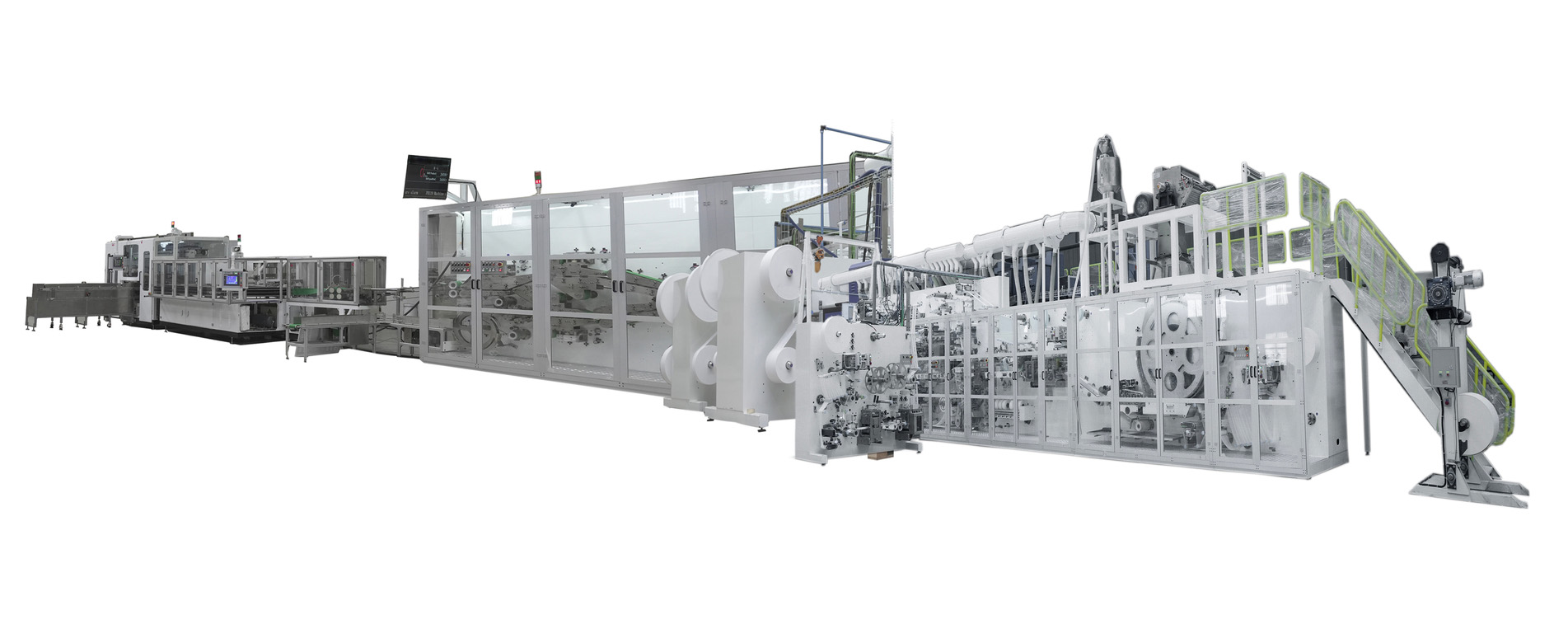
A pull-up diaper production line differs substantially from a standard flat diaper or tape diaper machine. The core difference lies in the forming process. Traditional machines produce a flat chassis that is folded and taped around the wearer. Pull-up machines, by contrast, must create a continuous three-dimensional product with an elastic waistband on both the front and back panels, plus side seams that are bonded ultrasonically or thermally.
This means a dedicated pull-up machine requires additional modules: elastic waistband applicators, side seam bonding stations, and often a leg-hole elastic system that operates differently from standard diaper manufacturing. The mechanical complexity is higher, but so is the value-add per unit. Manufacturers who master this technology can command premium pricing and capture market share from competitors limited to basic tape-style products.
Comparison: Pull-Up vs. Traditional Tape Diaper Production
Feature
Pull-Up Diaper Machine
Tape Diaper Machine
Product Form
Underwear-style, pull-on
Flat chassis with adhesive tapes
Waistband
360° elastic front + back
Rear elastic only (typically)
Side Closure
Ultrasonic/thermal seam bonding
Re-fastenable tape tabs
Production Speed
200–400 pcs/min (advanced models)
300–600 pcs/min
Machine Investment
Higher (more complex modules)
Moderate
Profit Margin per Unit
Higher (premium product category)
Lower (commodity pricing)
Choosing the Right Pull-Up Production Line
When evaluating a pull-up diaper production line, manufacturers should prioritize full-servo servo-driven systems. Servo technology allows independent motor control on each module — pulp mill, SAP dosing, waist elastic, and side seam bonding — which translates to faster size changeovers, less material waste, and higher overall equipment effectiveness (OEE). Modern full-servo machines can switch between different product sizes in under 10 minutes, a critical feature for contract manufacturers who produce multiple SKUs on the same line.
Another key consideration is the waistband system. High-quality pull-ups require consistent, uniform elastic distribution around the waist to prevent sagging or leakage. A proper baby diaper making machine adapted for pull-up production must feature precision elastic placement with adjustable tension control. Without this, the finished product will lack the snug, comfortable fit that consumers expect from premium pull-up diapers.
The Future: Convertible Lines and Multi-Function Machines
The latest trend in hygiene product manufacturing is convertible production lines that can run both tape diapers and pull-ups on the same platform with modular reconfiguration. This approach reduces capital expenditure risk — a manufacturer can start with tape diaper production and upgrade to pull-up capability as the market matures. Some advanced machines from leading suppliers now offer hybrid configurations where 60–70% of the machine frame is shared between product types, with only the forming drum and bonding modules swapped during changeovers.
For factory owners and production managers planning capacity expansion, the pull-up segment represents the clearest growth opportunity in the hygiene sector today. With the right machine configuration and a focus on quality consistency, manufacturers can differentiate themselves and capture the premium tier of this rapidly expanding market.