The global baby diaper market continues its steady expansion, valued at over $85 billion in 2026 and projected to exceed $120 billion by 2032. For manufacturers looking to enter or scale in this space, the production line you choose is not just a machine purchase — it is a long-term capital investment that defines your production capacity, product quality, and ultimately your profitability.
Unlike small-scale tabletop machines or entry-level lines, heavy-duty industrial baby diaper production lines represent a completely different class of equipment. These are full-scale manufacturing systems designed for sustained high-volume output, precision engineering, and decades of service life. With price tags ranging from $200,000 to $850,000+, they demand careful evaluation before commitment.
This guide provides a comprehensive technical and commercial overview of baby diaper production lines, covering core technologies, key specification comparisons, cost analysis, and ROI considerations for serious manufacturers.
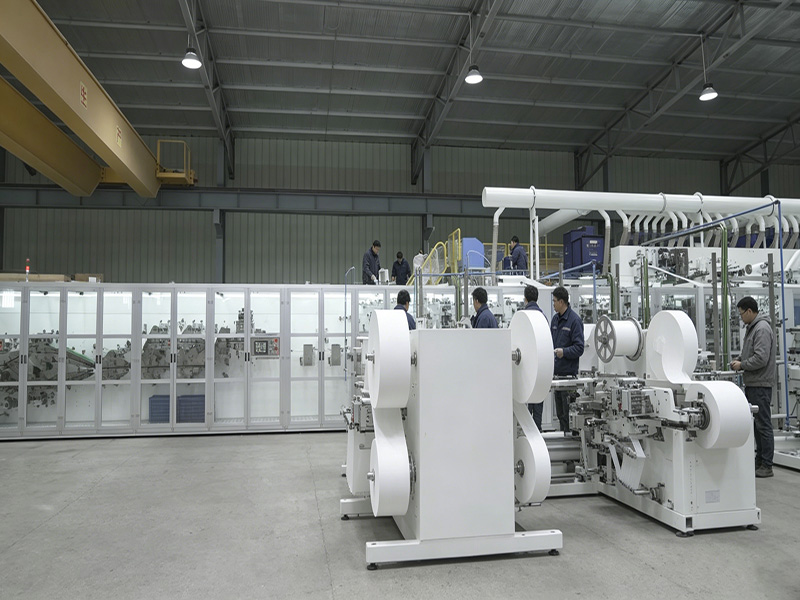
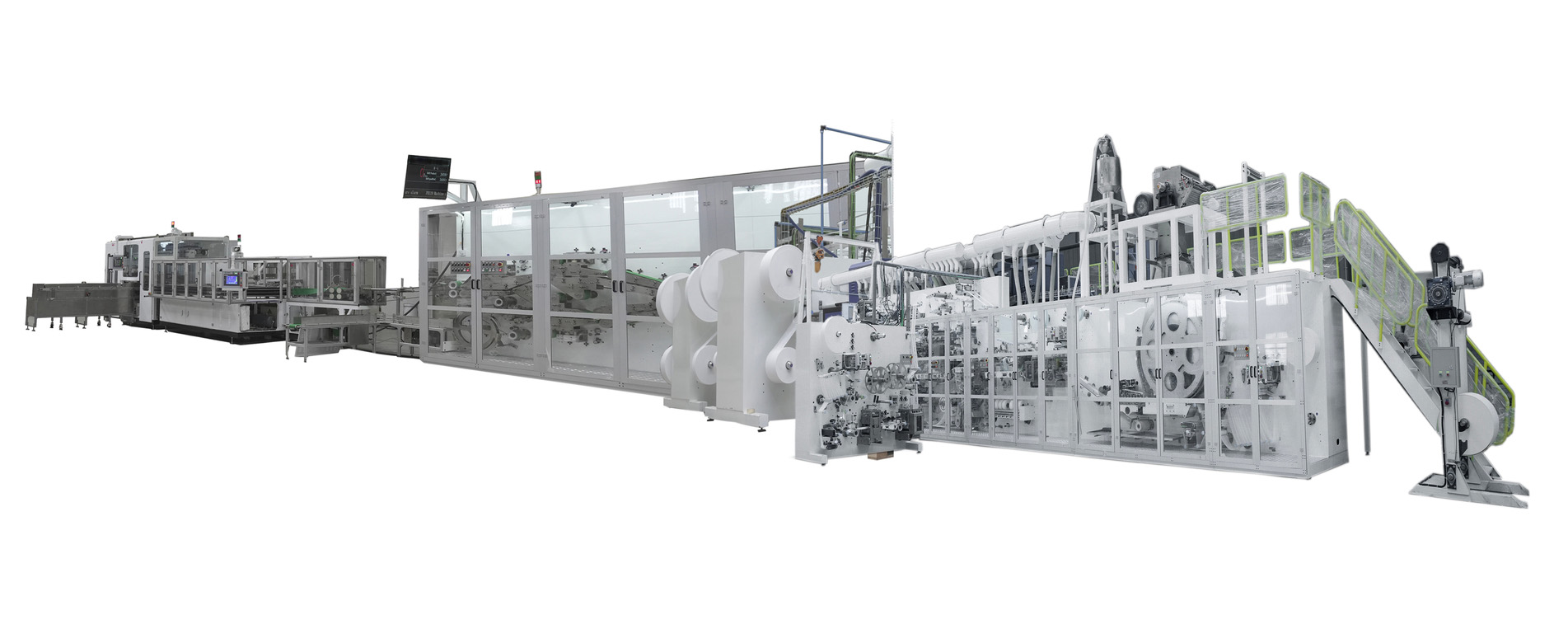
A full-scale baby diaper production line is an integrated manufacturing system that combines multiple process stations into a single synchronized production flow. From raw material unwinding to finished product packaging, every stage is automated and controlled.
The critical distinction between a light-industrial machine and a heavy-duty production line comes down to three factors:
1. Production Speed & Stability
A heavy-duty line operates at sustained speeds of 400–600 diapers per minute (design speeds up to 1,200 ppm), running 24/7 with minimal downtime. Entry-level machines rarely exceed 150–200 ppm and cannot maintain continuous operation without frequent maintenance stops.
2. Full Servo-Driven Architecture
Modern high-end lines employ full servo motor control across all critical axes — unwinding, pulp forming, SAP dosing, elastic application, cutting, folding, and stacking. This eliminates mechanical transmission chains, reduces wear parts by 60%+, and delivers micron-level precision that mechanical cam-driven systems cannot match.
3. Industrial Build Quality
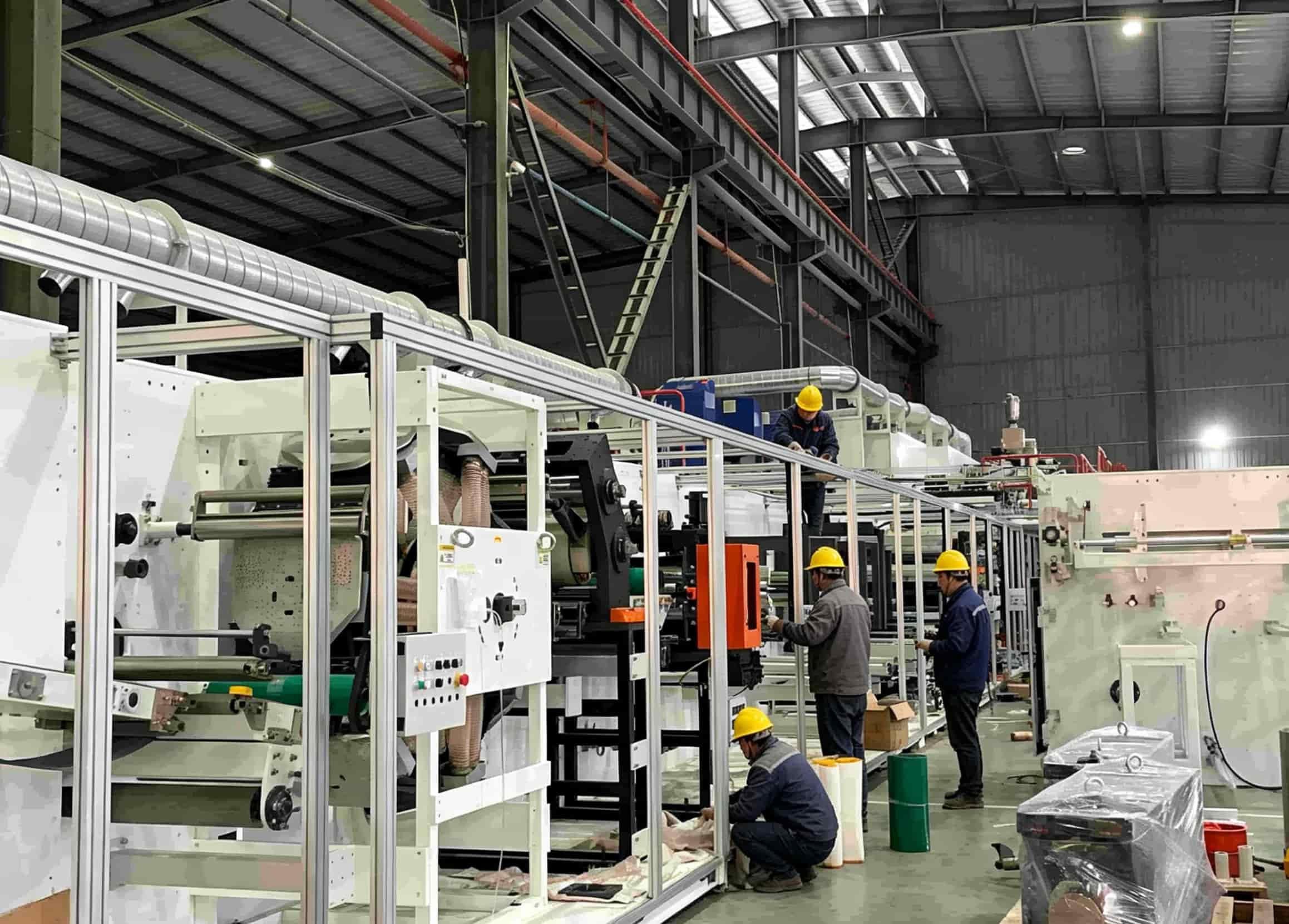
Heavy-duty lines weigh 60–80 tons, with cast-iron frames, industrial-grade bearings, and PLC-controlled servo drives rated for continuous industrial operation. These are factory-floor anchors, not benchtop machines — a true heavy duty diaper manufacturing equipment designed for decades of productive service.
The heart of any modern diaper line is its servo drive system. Unlike traditional mechanical drives that rely on gears, belts, and clutches, full-servo systems provide:
| Specification | Traditional Mechanical Drive | Full Servo Drive |
|---|---|---|
| Positioning Accuracy | ±0.5 mm | ±0.05 mm |
| Speed Range | Fixed ratios, manual adjustment | 0–100% programmable |
| Changeover Time | 2–4 hours | 15–30 minutes |
| Maintenance Interval | Every 500 hours | Every 3,000 hours |
| Energy Efficiency | 60–70% | 85–92% |
| Waste Rate | 3–5% | 0.5–1.5% |
| Noise Level | 85–95 dB | 70–78 dB |
| Spare Parts Cost | High (mechanical wear) | Low (fewer moving parts) |
Table: Performance comparison between traditional mechanical and full-servo drive systems for diaper production.
A complete baby diaper production line typically includes these stations:
1. Raw Material Unwinding — Multiple servo-controlled unwinders manage topsheet, backsheet, acquisition layer, leg cuffs, elastics, tapes, and SAP materials simultaneously. Automatic tension control and zero-speed splicing ensure continuous operation without stops.
2. Core Forming System — High-speed pulp mills (teeth-type crushers) process fluff pulp at up to 600 kg/hour, combined with precision SAP dosing. Web-wheel molding creates uniform core shapes with controlled density distribution.
3. Elastic Application — Servo-driven elastic placement systems apply leg and waist elastics with programmable tension and spacing. This directly impacts fit quality and leak protection.
4. Shaping & Embossing — Vacuum forming drums shape the diaper chassis. Optional embossing modules add brand-specific patterns and acquisition channels.
5. Folding & Packaging — High-speed folding units (tri-fold, double-fold) operate at line speed without accumulation. Automated stacking and packaging complete the production line.
When evaluating a heavy-duty baby diaper line, here are the critical commercial parameters to review:
| Parameter | Entry-Level Line | Heavy-Duty Industrial Line |
|---|---|---|
| Investment Range | $160,000 – $800,000 | |
| Max Design Speed | 200–300 ppm | 600–1,200 ppm |
| Stable Operating Speed | 120–180 ppm | 400–600 ppm |
| Product Size Range | 1–2 sizes | S, M, L, XL (customizable) |
| Qualified Rate | 92–95% | ≥98% |
| Power Consumption | 120–180 KW | 250–400 KW |
| Machine Weight | 15–25 tons | 60–80 tons |
| Footprint | 20m × 5m | 30m × 9m |
| Service Life | 5–8 years | 15–20 years |
| ROI Period | 18–24 months | 8–14 months |
Table: Commercial comparison between entry-level and heavy-duty industrial baby diaper production lines.
At first glance, a $500,000+ production line appears daunting compared to a $100,000 entry-level machine. However, the per-unit economics tell a different story.
Production Volume Advantage
A heavy-duty line producing 400 diapers per minute at 90% OEE generates approximately 17 million diapers per month (single-shift basis). An entry-level line at 150 ppm produces roughly 6 million — a 3× output gap.
Per-Unit Cost Reduction
The capital cost per diaper produced drops dramatically at scale. A $500,000 line depreciated over 15 years at 400 ppm yields a per-diaper equipment cost of approximately $0.0008, compared to $0.003 for a $100,000 entry-level line over 8 years at 150 ppm.
Material Efficiency
Full-servo control reduces material waste from 3–5% down to 0.5–1.5%. For a facility producing 200 million diapers annually, this represents material savings of $400,000–$800,000 per year in SAP, pulp, and nonwoven materials alone.
Not all heavy-duty line manufacturers are equal. When evaluating suppliers, consider:
Investing in a heavy-duty baby diaper production line is a strategic decision that goes far beyond machine specifications. It is a bet on market growth, production efficiency, and long-term competitiveness.
For manufacturers targeting serious scale — 50 million+ diapers per year — the heavy-duty full-servo line is not an expense; it is a profit center. The lower per-unit cost, higher output quality, and longer service life create a durable competitive advantage that entry-level equipment simply cannot match.
If you are evaluating a new production line investment, contact our engineering team for a detailed capacity analysis and equipment proposal tailored to your production requirements.
WhatsApp : +8615859535393
Email : aria@firstonemachine.com
Tel : +86 -15859535393


Tel: +86 -15859535393 Email: aria@firstonemachine.com